Graffiti Removal in Queens: How Fast You Act Determines How Much You Pay
You noticed the spray paint on your wall this morning. Maybe it was there last night, maybe it happened over the weekend. Here’s what you need to know right now: every hour that graffiti sits on your Queens or Long Island property, it becomes more difficult and more expensive to remove. Fast action isn’t just the right call it’s the financially smart one.
Graffiti vandalism is a reality for property owners across Queens, Nassau County, and Long Island. From residential fences in Flushing to commercial storefronts in Hempstead, no property type is immune. What separates a quick, affordable removal from a costly multi-treatment restoration is almost always one thing: response time.
Why Graffiti Gets Harder to Remove Over Time
Fresh spray paint — especially in the first 24 to 48 hours — has not yet fully cured or bonded into the pores of your surface. On concrete, brick, stucco, or wood, paint penetrates deeper with every passing hour as it cures and hardens. What might lift off cleanly with the right solvent and pressure on day one can require multiple aggressive treatments, more powerful chemicals, and significantly more labor by day seven.
Sun exposure speeds the curing process. Heat from Long Island summers bakes paint into masonry and concrete faster. Rain doesn’t help either — water can drive pigment deeper into porous surfaces. The combination means that a graffiti tag left over a summer weekend in Queens could be two to three times harder to remove by Monday morning than it would have been Saturday night.
Key Rule: Contact a professional graffiti removal service within 24–48 hours of discovery. Every hour of delay increases both difficulty and cost.
The Graffiti Removal Timeline: What Happens to Your Surface
Best Case Scenario - 0–24 hrs
Paint is fresh and largely surface-level. Professional solvent application and controlled pressure washing can achieve clean removal on most surfaces in a single treatment with minimal surface disruption.
Still Manageable - 24–72 hrs
Paint has begun to cure. Removal is still achievable in one or two treatments on most surfaces, but may require stronger chemical dwell time and higher-effort pressure washing. Cost increases moderately.
Significantly More Difficult -3–7 days
Paint is largely cured and has penetrated porous surfaces like brick, concrete, and stucco. Multiple treatments likely required. On older brick, ghost staining — a faint outline that remains even after paint removal — becomes a real risk.
Hardest and Most Expensive -7+ days
Fully cured paint deeply embedded in surface pores. May require aggressive chemical stripping, multiple pressure wash passes, and in some cases surface restoration or repainting. Cost is highest at this stage.
The Graffiti Attraction Effect: Why One Tag Becomes Ten
There’s a well-documented phenomenon in urban property management: visible graffiti attracts more graffiti. Vandals actively seek out properties that already show tags, treating them as lower-risk targets. In Queens neighborhoods and commercial corridors throughout Nassau County, a single piece of graffiti left unaddressed for even a week can signal to others that the property isn’t being watched — inviting repeat vandalism.
Fast removal is therefore not just about cleaning up today’s damage. It’s a deterrent strategy. Properties that respond quickly to graffiti consistently see lower rates of repeat vandalism than properties where tags are left up for extended periods. Speed of removal is, in itself, a form of property protection.
Surface Types and What They Mean for Removal
| Surface | Graffiti Behavior | Removal Approach | Risk If Delayed |
|---|---|---|---|
| Painted Brick | Paint bonds to existing paint layer | Chemical solvent + low-pressure wash | Moderate — ghost staining possible |
| Bare Brick / Masonry | Paint penetrates pores deeply | Poultice treatment + pressure washing | High — permanent ghost stain risk |
| Concrete / Sidewalk | Fast penetration into pores | Degreaser solvent + pressure wash | High — deep staining after 72 hrs |
| Metal (fences, shutters) | Surface bond, doesn’t penetrate | Solvent wash, sometimes sandblasting | Low to moderate — surface rust risk |
| Vinyl Siding | Can penetrate with heat or age | Gentle solvent, soft wash technique | Moderate — may require panel replacement |
| Stucco | Very porous — rapid penetration | Chemical treatment + controlled wash | High — often requires repainting |
What Professional Graffiti Removal Actually Looks Like
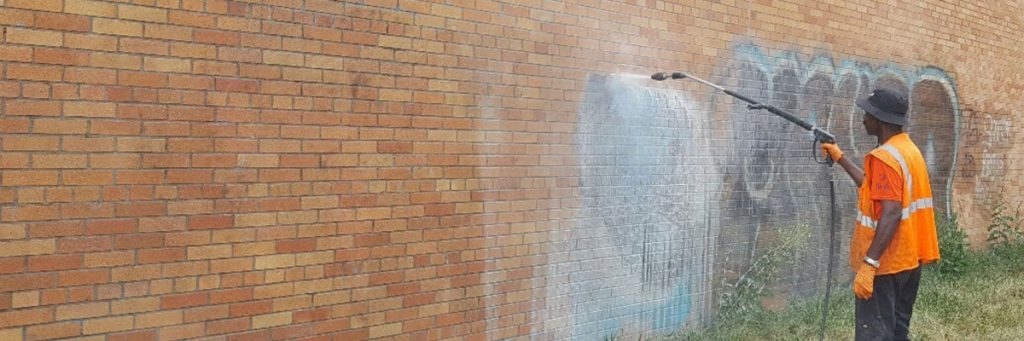
DIY graffiti removal attempts — pressure washers rented from a hardware store, consumer-grade solvents from a paint shop — often make the situation worse. The wrong chemical on brick can set the stain permanently. Too much pressure on stucco or older masonry can damage the surface itself. Without knowing the specific surface and paint type, it’s easy to turn a removable tag into a surface restoration project.
At County Wide Power Wash & Restoration, we approach every graffiti job by first identifying the surface material and the type of paint used. We use professional-grade, surface-appropriate solvents with the correct dwell time, followed by the right pressure washing technique for that specific surface. The goal is always complete removal in as few treatments as possible, with zero additional damage to your property.
We’re available 24/7 for emergency graffiti removal across Queens, Nassau County, and the surrounding Long Island area. We understand that for a business owner, a graffiti-covered storefront on a Monday morning isn’t something you can schedule for next week — it needs to come down today.
Frequently Asked Questions
Can all graffiti be completely removed?
In most cases, yes — especially when addressed quickly. On highly porous surfaces like bare brick or old stucco, graffiti that has been left for an extended period may leave a faint ghost stain even after thorough treatment. In those cases, we’ll discuss your options including surface repainting or anti-graffiti coating application.
Do you offer 24/7 emergency graffiti removal in Queens and Nassau County?
Yes. We offer 24/7 emergency response for graffiti vandalism throughout Queens, Nassau County, Suffolk County, and surrounding Long Island communities. Call us as soon as you discover the graffiti — faster response means better results and lower cost.
Will graffiti removal damage my brick or masonry?
Not when performed correctly. We use surface-appropriate solvents and controlled pressure washing specifically calibrated to your surface type. Aggressive or improper techniques — which is the risk with DIY approaches — can damage masonry. Our process prioritizes surface preservation alongside complete paint removal.
Is there anything I can do to prevent graffiti from happening again?
Yes. Anti-graffiti coatings are a highly effective preventive measure. Applied to your surface after cleaning, these clear coatings create a non-porous barrier that prevents paint from bonding — making future removal far easier and faster. We offer anti-graffiti coating application as an add-on to our removal service.
Does my homeowner's or business insurance cover graffiti removal?
Many property insurance policies include vandalism coverage that may cover graffiti removal costs. We recommend contacting your insurance provider as soon as you discover the graffiti. We can provide documentation and itemized invoices to support your claim.
How much does graffiti removal cost in Queens or Nassau County?
Cost depends on the size of the affected area, the surface type, how long the graffiti has been there, and how many treatments are required. Fresh graffiti on a simple surface is significantly less expensive than aged tags on porous masonry. Contact us for a free on-site assessment and quote — we’ll be transparent about what’s involved and what it will cost before any work begins.